

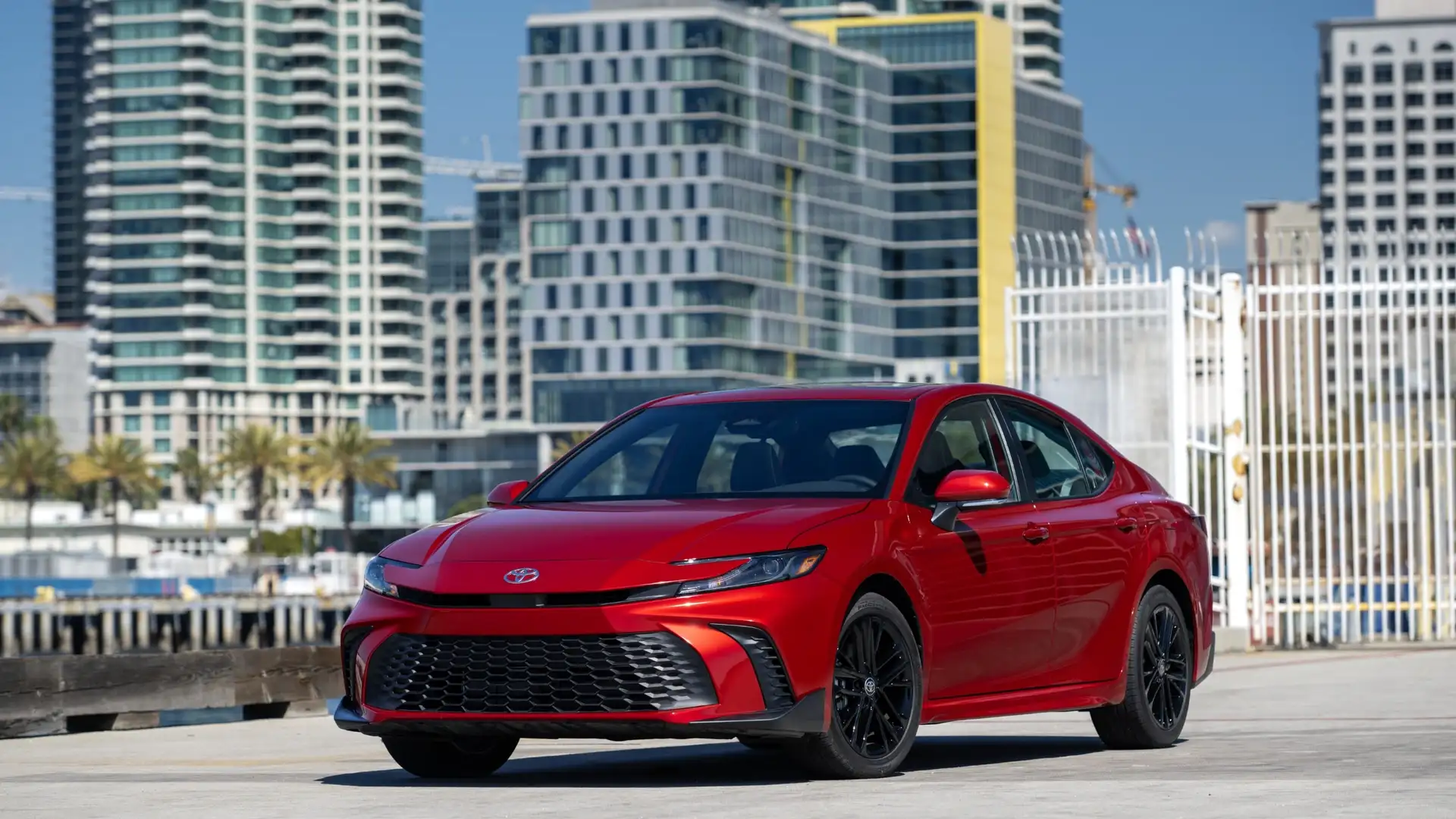
The 2026 Toyota Camry in Hagerstown, MD
The 2026 Toyota Camry is engineered exclusively around a hybrid powertrain system that integrates a gasoline engine with electric motor components to deliver consistent efficiency and controlled performance. This model uses a 2.5-liter, 4-cylinder engine constructed with an alloy block and aluminum alloy head. The engine features a 16-valve dual overhead camshaft design with chain drive operation and a displacement of 2,487 cubic centimeters. Bore and stroke measurements are 3.44 inches by 4.07 inches, paired with a compression ratio of 14.0:1. The engine produces 184 horsepower at 6,000 rpm and 163 lb-ft of torque at 5,200 rpm, operating on 87-octane unleaded fuel.
When combined with the hybrid system, total output reaches 225 horsepower in front-wheel drive configurations and 232 horsepower in all-wheel drive configurations. The hybrid system uses a permanent magnet synchronous motor that delivers 100 kW of power to the front axle. All-wheel drive models include a rear-mounted electric motor rated at 30 kW, contributing to improved traction and system balance. The hybrid battery pack is a lithium-ion unit with a nominal voltage of 251.6 volts, composed of 68 cells at 3.7 volts each, and a capacity of 4.0 ampere-hours. Maximum system voltage reaches 600 volts, supporting consistent power delivery during acceleration and sustained driving.
Digital Displays and Multimedia Integration
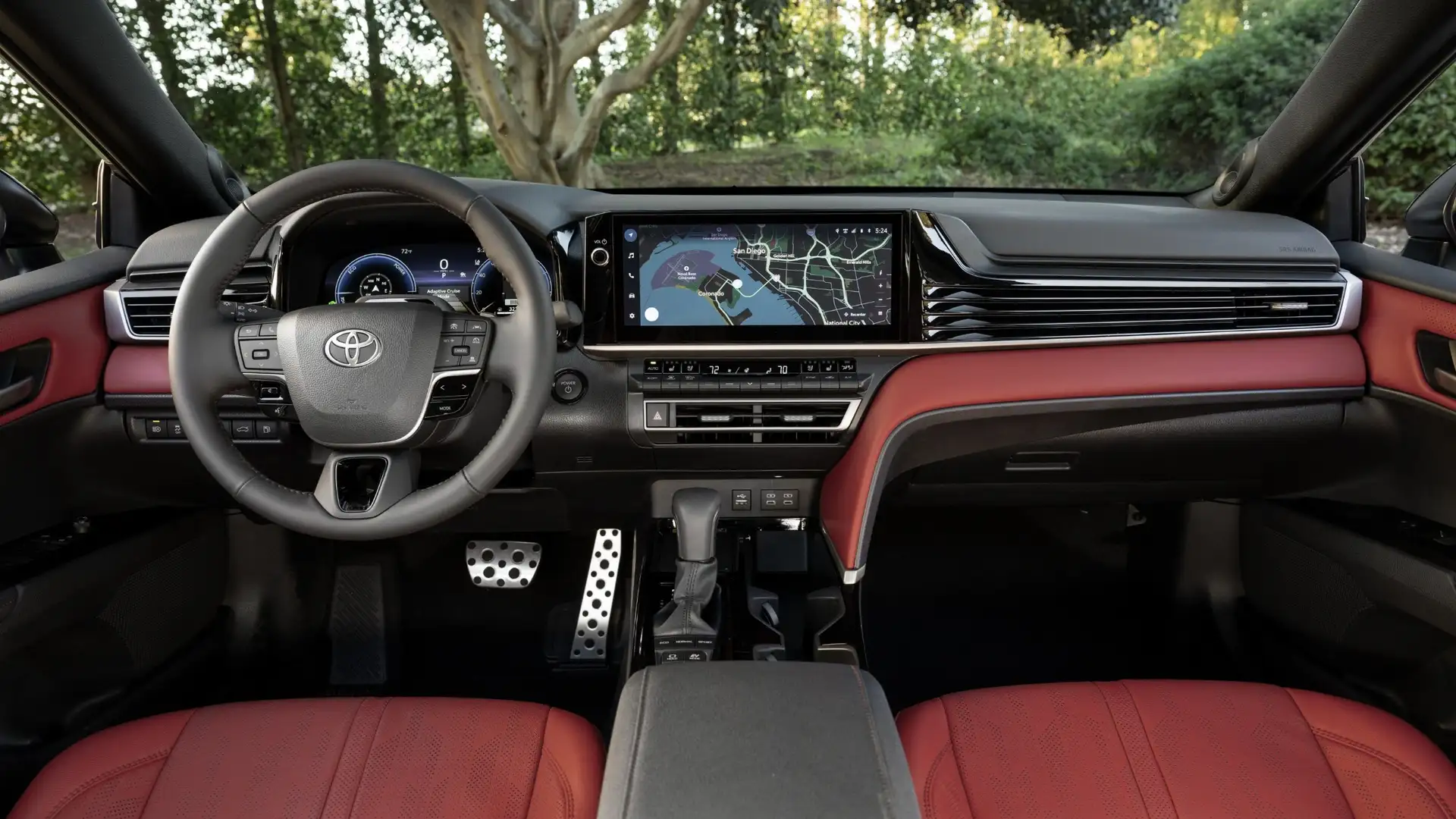
The 2026 Toyota Camry integrates digital display systems to present vehicle data and multimedia functions. Standard configurations include a 7-inch digital gauge cluster, while higher trims include a 12.3-inch digital display with selectable information screens. These displays provide vehicle status, hybrid system data, fuel economy metrics, and driver assistance notifications.
The infotainment system includes either an 8-inch or 12.3-inch touchscreen interface. Wireless Apple CarPlay® and Android Auto™ compatibility are standard across all trims, supporting smartphone integration. Audio systems include a standard 6-speaker configuration, with an available 9-speaker JBL® premium audio system that includes a subwoofer and amplifier.
Additional technology features include a head-up display that projects information such as speed, navigation, and system indicators onto the windshield. Connected services support remote vehicle interaction, navigation assistance, and Wi-Fi connectivity.
Interior Dimensions and Cabin Configuration
The interior of the 2026 Toyota Camry is designed to accommodate five passengers. Front headroom measures 38.3 inches, while rear headroom measures 37.6 inches. Models equipped with a moonroof have slightly adjusted front headroom at 37.5 inches. Front legroom is 42.1 inches, and rear legroom is 38.0 inches. Shoulder room measures 57.7 inches in the front and 55.7 inches in the rear, while hip room measures 55.4 inches in the front and 54.6 inches in the rear.
Total passenger volume reaches up to 99.9 cubic feet, or 98.8 cubic feet in models with a moonroof. Cargo volume is 15.1 cubic feet, providing storage capacity for daily use.
Interior Systems and Functional Equipment
The cabin includes a range of functional systems designed to support usability and convenience. Standard features include push-button start, an electric parking brake with brake hold functionality, and power windows with auto up and down capability and jam protection. The vehicle also includes a multi-function key fob with remote entry and trunk release functions.
Dual-zone automatic climate control includes an air filter and humidity sensor, along with rear-seat vents for consistent airflow distribution. Interior configurations vary by trim, with seating materials ranging from fabric to SofTex® and leather-trimmed options. Higher trims include power-adjustable seating with lumbar support and memory functions, as well as heated and ventilated front seats.
Additional interior systems include wireless device charging, five USB ports distributed between front and rear seating areas, and a 12-volt auxiliary power outlet. Ambient interior lighting is available on higher trims, contributing to interior visibility.
Hybrid Efficiency and Fuel Economy Metrics
Fuel efficiency is a defining attribute of the 2026 Toyota Camry hybrid system. Front-wheel drive LE models achieve an estimated 53 miles per gallon in city driving, 50 miles per gallon on the highway, and a combined rating of 51 miles per gallon. All-wheel drive LE variants produce slightly adjusted figures of 51 miles per gallon in the city, 49 miles per gallon on the highway, and 50 miles per gallon combined. Other trims such as SE, Nightshade, XLE, and XSE maintain competitive efficiency ranges, with combined ratings between 44 and 47 miles per gallon depending on drivetrain configuration.
The integration of the hybrid system with the electronically controlled continuously variable transmission supports efficient energy distribution between the gasoline engine and electric motors. Predictive Fuel-Efficient Drive technology adjusts energy usage based on driving patterns, contributing to consistent fuel consumption performance. The system operates without requiring external charging, maintaining convenience while optimizing efficiency.
Disclaimer: * EPA-estimated 52 city/49 hwy/51 combined mpg rating for 2026 Camry LE; 50 city/49 hwy/50 combined mpg rating for 2026 Camry LE AWD; 47 city/45 hwy/46 combined mpg rating for 2026 Camry SE, XLE and XSE; 46 city/46 hwy/46 combined mpg rating for 2026 Camry SE AWD and XLE AWD; 43 city/43 hwy/43 combined mpg rating for 2026 Camry XSE AWD. Use for comparison purposes only. Your mileage will vary for many reasons, including your vehicle’s condition and how/where you drive. See www.fueleconomy.gov.
Transmission Functionality and Drivetrain Configuration
The transmission system in the 2026 Toyota Camry is an electronically controlled continuously variable transmission. This configuration enables smooth acceleration and consistent engine operation by adjusting gear ratios without fixed steps. The eCVT integrates with the hybrid system to manage transitions between electric-only driving, hybrid operation, and engine-assisted propulsion.
All-wheel drive models use an independent rear electric motor rather than a mechanical driveshaft. This design reduces mechanical complexity and supports efficient torque distribution between the front and rear axles. The system activates rear-wheel assistance as needed, enhancing traction during acceleration or when driving on low-grip surfaces.
Chassis Structure and Suspension Design
The chassis of the 2026 Toyota Camry uses a front independent MacPherson® strut suspension with a stabilizer bar. The rear suspension is a multi-link configuration, also equipped with a stabilizer bar, providing improved handling stability and ride consistency. Selected trims, including SE, Nightshade, and XSE include sport-tuned shocks and springs, along with front strut tower bracing to increase rigidity and improve cornering control.
Stabilizer bar diameters vary depending on trim and drivetrain. Front and rear measurements range from 25.4 mm to 27.0 mm in the front and 22.2 mm to 26.0 mm in the rear, depending on configuration. Electric power steering uses a rack-and-pinion system with electric assist, providing accurate steering input and reduced energy consumption compared to hydraulic systems. The turning circle diameter is 37.4 feet, supporting maneuverability in confined spaces.
Braking System and Wheel Specifications
The braking system uses an electronically controlled brake system that coordinates regenerative and friction braking. Front brakes consist of ventilated discs with a diameter of 12 inches, while the rear uses solid discs measuring 11.06 inches. Anti-lock braking is standard, contributing to controlled stopping performance.
Wheel sizes vary by trim level. The LE model uses 16-inch by 6.5-inch alloy wheels paired with P205/65R16 all-season tires. The SE and XLE trims use 18-inch by 8-inch wheels with P235/45 R18 tires. The Nightshade and XSE trims use 19-inch by 9-inch wheels with P235/40 R19 tires. A temporary spare tire is included for emergency use.
Exterior Dimensions and Structural Measurements
The 2026 Toyota Camry maintains dimensions consistent with a midsize sedan classification. The wheelbase measures 111.2 inches, while the overall length is 193.5 inches. The width is 72.4 inches, and the overall height is 56.9 inches. Ground clearance is 5.4 inches, supporting stable road handling and accessibility.
Tread width varies by trim, with front measurements ranging from 62.2 inches to 63.0 inches and rear measurements ranging from 62.8 inches to 63.6 inches. These dimensions contribute to vehicle stability and balanced weight distribution across different configurations.
Advanced Driver Assistance and Safety Integration
The 2026 Toyota Camry includes Toyota Safety Sense™ 3.0 as standard equipment across all trims. This system integrates multiple driver assistance technologies designed to support awareness and reduce collision risk. The system includes a pre-collision system with pedestrian detection, dynamic radar cruise control, lane departure alert with steering assist, lane tracing assist, road sign assist, automatic high beams, and proactive driving assist.
Additional safety systems include blind spot monitoring with rear cross-traffic alert and safe exit alert. The vehicle is equipped with eight airbags and a tire pressure monitoring system with direct readout and individual tire location alerts. Hill start assist control and a rear-seat reminder are also included.
Higher trim levels and optional packages introduce additional driver assistance technologies such as a panoramic view monitor with a 360-degree overhead view, front cross-traffic alert, lane change assist, and a driver monitor sensor. Parking assistance systems include front and rear sensors with automatic braking capability and rear cross-traffic braking. A backup camera with dynamic gridlines is standard across all trims.
Structural Safety and Stability Systems
The 2026 Toyota Camry integrates a comprehensive set of stability and braking technologies within the Star Safety System. This system includes enhanced vehicle stability control, traction control, anti-lock braking, electronic brake-force distribution, brake assist, and smart stop technology. These systems operate together to maintain vehicle stability during acceleration, cornering, and braking.
Additional safety features include child-protector rear door locks, a LATCH system for child seat installation, and collision sensors that deactivate the high-voltage traction battery in the event of an impact. These systems are designed to support occupant protection and vehicle stability during operation.
Schedule a Test Ride Today
Drivers interested in examining the technical capabilities of the 2026 Toyota Camry can arrange a test drive to evaluate its hybrid system, drivetrain response, and integrated safety features. Our dealership team at Younger Toyota in Hagerstown, MD provides access to available trims and configurations for detailed inspection. A scheduled a test drive allows direct assessment of fuel efficiency performance, digital interface functionality, and driver assistance systems. Experiencing the vehicle in motion provides clarity on its acceleration characteristics, braking response, and ride stability. Contact our dealership to arrange a convenient appointment and review the full range of specifications in person.
Contact Us