

2026 Toyota C-HR in Hagerstown, MD
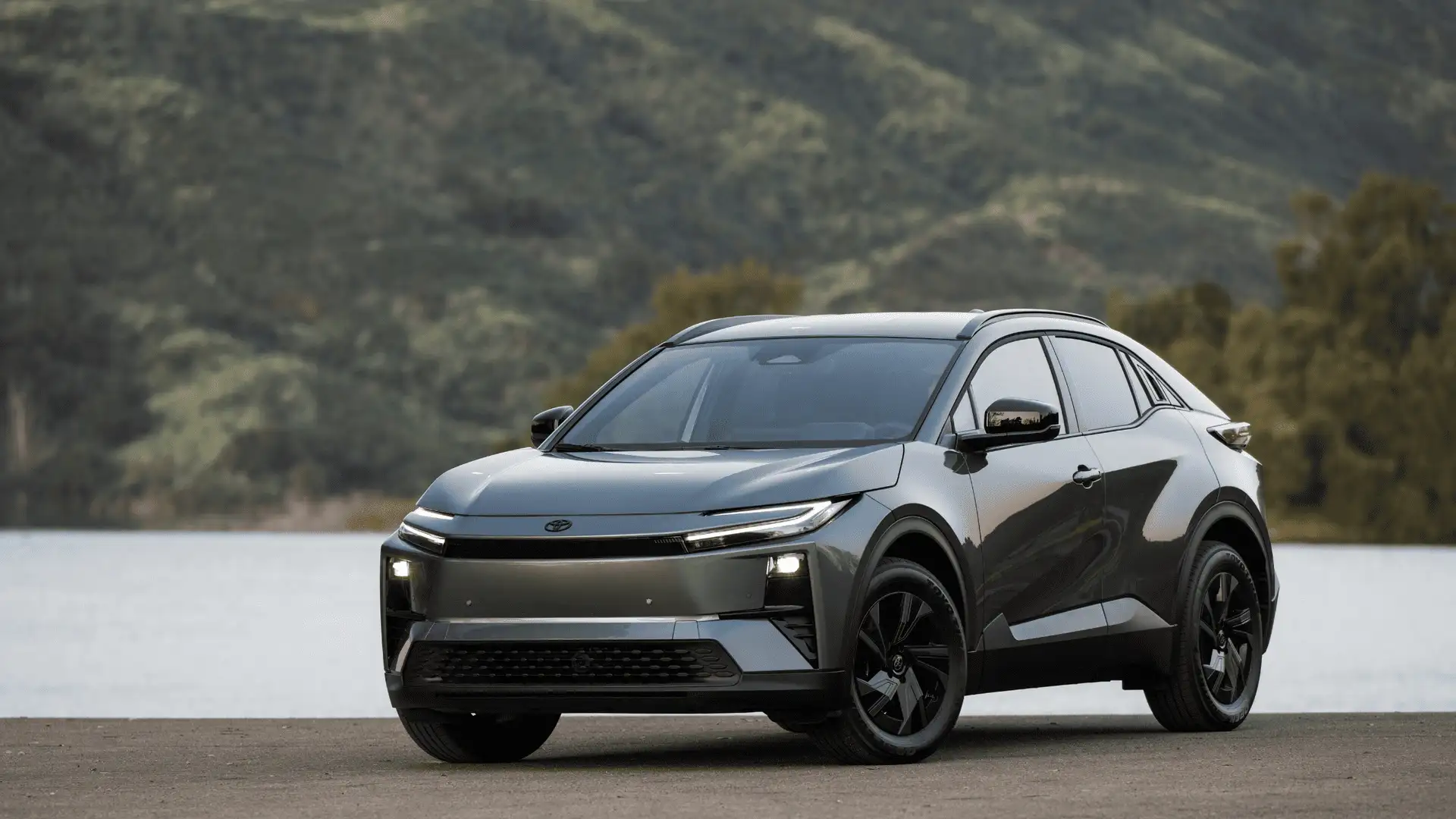
The 2026 Toyota C-HR is a five-passenger small electric SUV available in SE AWD and XSE AWD grades. Its dual-motor electric system generates 338 combined net horsepower and supports a manufacturer-estimated 0-to-60-mph time of 4.9 seconds for both grades. A 74.7-kWh lithium-ion battery, standard all-wheel drive, and compatibility with several charging levels define its propulsion system. Independent front and rear suspension designs work with electric power steering and four-wheel ventilated disc brakes to support controlled handling. The technical package also includes a 14-inch multimedia system, flexible cargo space, connected services, and a comprehensive collection of driver-assistance and occupant-protection technologies.
Multimedia, connectivity, and safety technology
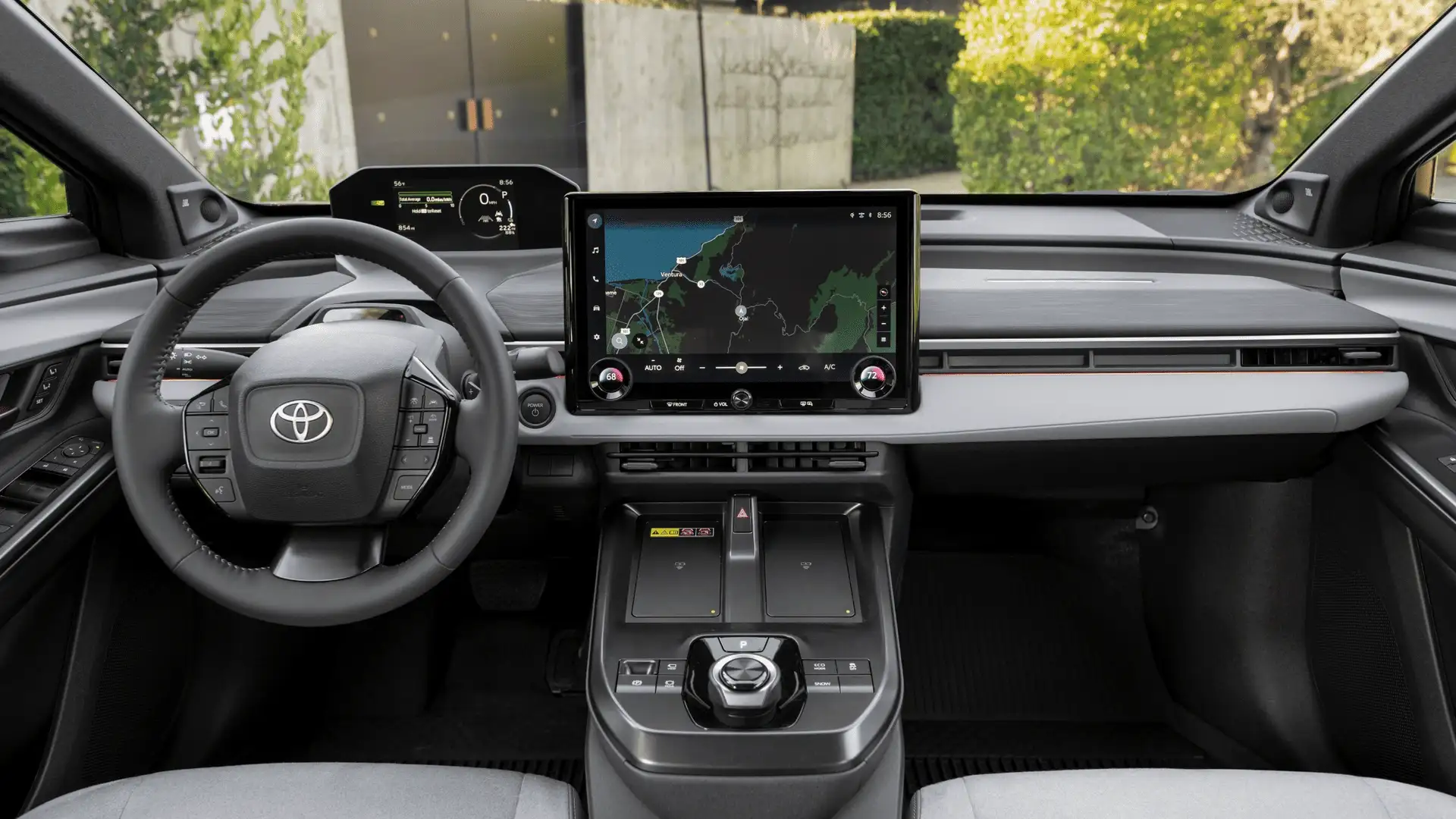
Technology in the 2026 Toyota C-HR covers driver information, smartphone integration, connected services, parking assistance, and active safety. A 14-inch Toyota Audio Multimedia system is standard on both grades. The vehicle also provides wireless charging and several wired power connections. Toyota Safety Sense 3.0 and the Star Safety System are standard throughout the range. The XSE AWD adds several driver-assistance features that are not included on the SE AWD.
Displays, audio, and device support
The 14-inch Toyota Audio Multimedia system includes six speakers. Wireless Apple CarPlay® and Android Auto™ compatibility are standard. A nine-speaker JBL® Premium Audio system with a subwoofer and amplifier is optional on the XSE AWD. Two Qi-compatible wireless smartphone chargers include full-charge indicator lights. Three USB-C charging ports consist of one 15-watt front port and two rear ports with a maximum rating of 60 watts.
A front USB-C media port supports a wired media connection. One 12-volt, 120-watt auxiliary outlet is positioned in the lower storage tray. A top-mounted Multi-Information Display uses a 7-inch LCD screen. Displayed information includes the speedometer, charge meter, power-output meter, drive-mode indicators, odometer, tripmeters, clock, outside temperature, charging details, and warning messages. The display also supports customizable settings, a trip timer, rear-passenger seatbelt indicators, and driving-efficiency information.
Connected vehicle services
Safety Connect can provide access to an emergency-assistance button, automatic collision notification, enhanced roadside assistance, and a stolen-vehicle locator when its service requirements are met. Wi-Fi Connect supports an AT&T Wi-Fi hotspot and compatible integrated streaming through Apple Music and Amazon Music. Drive Connect includes cloud navigation with Google Points of Interest data, Destination Assist, and an Intelligent Assistant activated by the “Hey, Toyota” command. Remote Connect allows compatible Toyota app and smartwatch functions such as door locking and unlocking, parked-vehicle location, vehicle-status checks, remote operation, and guest-driver monitoring. Service Connect supplies personalized maintenance updates and vehicle-health reports, with connected functions dependent on applicable subscriptions and a 4G network.
Driver assistance and occupant protection
Toyota Safety Sense 3.0 is standard on both 2026 Toyota C-HR grades. Its systems include a Pre-Collision System with Pedestrian Detection, Lane Tracing Assist, Full-Speed Range Dynamic Radar Cruise Control, and Lane Departure Alert with Steering Assist. Automatic High Beams, Road Sign Assist, and Proactive Drive Assist are also part of the package. A Blind Spot Monitor with Rear Cross-Traffic Alert is standard. Safe Exit Alert and a backup camera with dynamic gridlines further support awareness around the vehicle.
The XSE AWD adds Lane Change Assist and Traffic Jam Assist, with Traffic Jam Assist requiring the applicable Drive Connect service and network connection. It also includes a Panoramic View Monitor that supplies a 360-degree overhead image during low-speed driving and reversing, along with a curb view. Front and Rear Parking Assist with Automatic Braking provides audible and visual warnings on the XSE AWD. Under certain conditions, the system may apply the brakes when it detects the possibility of contact with a stationary object or vehicle. A Vehicle Proximity Notification System is standard on both grades.
Eight airbags include driver and front-passenger airbags, seat-mounted side airbags for both front occupants, knee airbags for the driver and front passenger, and curtain-shield airbags covering the front and rear. Every seating position has a three-point seatbelt, with an Emergency Locking Retractor for the driver and Automatic/Emergency Locking Retractors for the passenger positions. Adjustable front shoulder anchors are standard. The LATCH system includes lower anchors on the outboard rear seats and tether anchors for all rear seating positions. Child-protector rear-door locks, a power-window lockout, an anti-theft alarm, and an engine immobilizer complete the listed occupant protection and security equipment.
Passenger comfort, cargo capacity, and cabin equipment
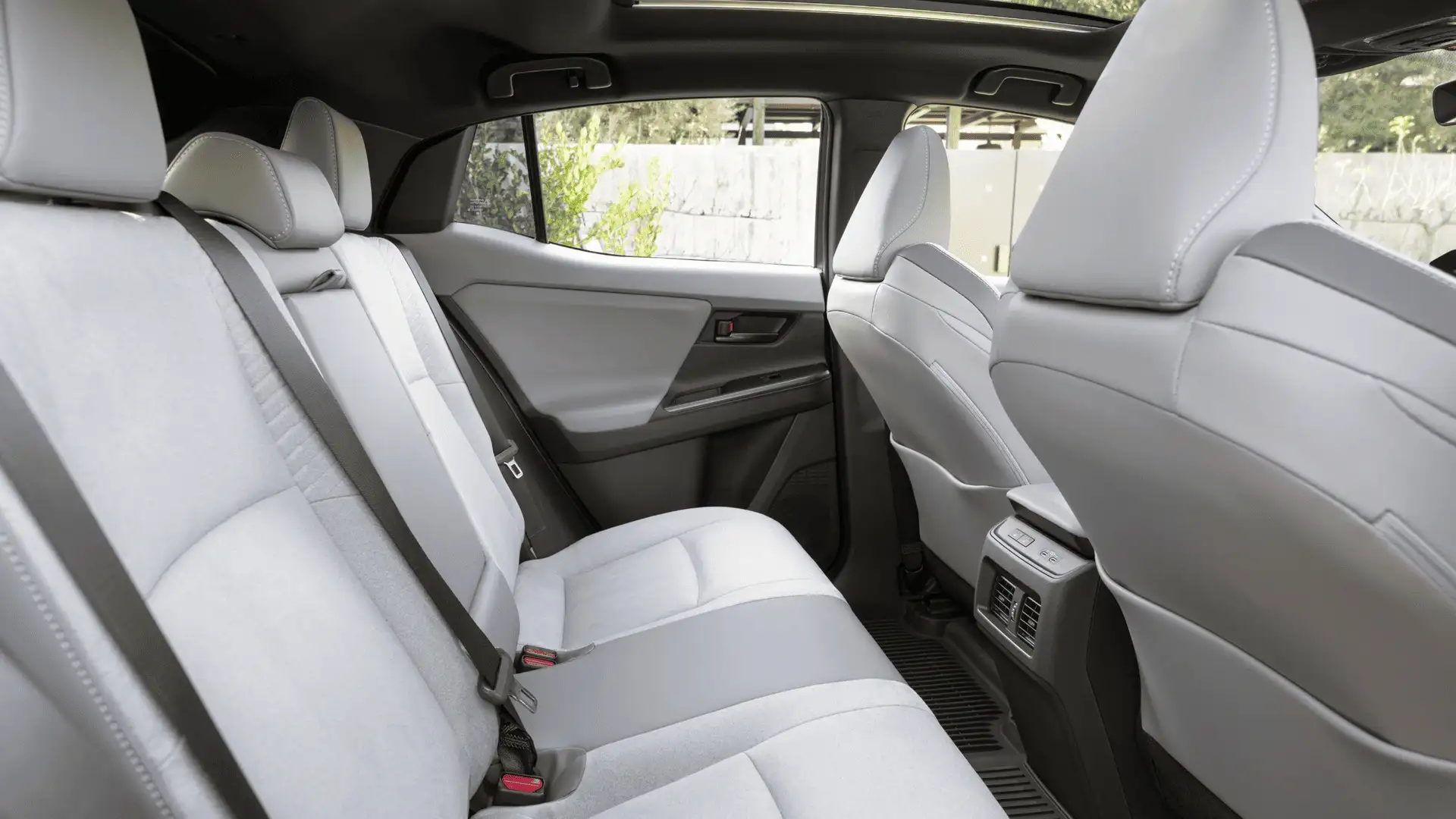
The 2026 Toyota C-HR seats five occupants and combines two-row accommodations with a fold-flat rear seating system. Standard heated front seats, dual-zone automatic climate control, and several storage areas support routine cabin use. Grade differences primarily involve upholstery, front-passenger seat adjustment, mirror equipment, and selected options. Published passenger measurements provide specific context for the front and rear seating areas. The cargo compartment expands when the second-row seatbacks are folded.
Seating dimensions and materials
Front headroom measures 39.11 inches without the panoramic sunroof and 38.62 inches with it. Rear headroom measures 37.53 inches with the standard roof and 36.38 inches with the panoramic sunroof. Front legroom is 42.12 inches, while rear legroom measures 32.19 inches. Shoulder room measures 58.04 inches in front and 54.68 inches in the rear. Hip room measures 54.45 inches for the front row and 44.78 inches for the rear row.
The SE AWD uses Fabric and SofTex®-trimmed seating. Its driver’s seat provides eight-way power adjustment and lumbar support, while the front-passenger seat has six-way manual adjustment. The XSE AWD uses Synthetic Suede and SofTex®-trimmed seats with eight-way power adjustment for both front occupants and lumbar support for the driver. Heated front seats are standard across the lineup, and heated rear seats are optional on the XSE AWD. Both grades also feature synthetic suede armrests and a SofTex®-trimmed center console.
A heated, leather-trimmed, three-spoke steering wheel is standard. Manual tilt and telescopic adjustment allow the driver to change the steering wheel position, while regenerative braking paddle switches are integrated into the wheel. The turn-signal stalk includes headlight controls and a one-touch, three-blink lane-change function. A separate stalk manages the windshield wipers. Sun visors with illuminated vanity mirrors and LED reading, dome, and cargo-area lights complete the primary cabin-lighting equipment.
Climate control, access, and interior lighting
Dual-zone automatic climate control is standard and includes a dust-and-pollen filtration system. Rear-seat vents distribute conditioned air beyond the front row. The Smart Key System operates through the front doors and works with Push Button Start, remote keyless entry, a panic function, and remote air-conditioning controls. Digital Key capability allows a compatible smartphone to function in place of the physical key when the required Remote Connect service and network connection are active. Power door locks include shift-linked automatic locking and unlocking.
Power windows provide automatic up-and-down operation and jam protection at every position. Front and rear ambient lighting offers 64 selectable colors. The SE AWD includes an auto-dimming rearview mirror, while the XSE AWD adds a HomeLink® universal transceiver. A rear liftgate-window defogger is standard. Matte-brushed dashboard trim, black interior door handles, black carpeting, and a driver-side footrest establish a consistent cabin equipment package across both grades.
Cargo space and storage features
Cargo volume measures 25.3 cubic feet behind the second row. Folding the rear seats expands capacity to 59.5 cubic feet behind the first row. The rear seat uses a 60/40 split and can recline or fold flat. It also includes a center armrest with cup holders. A cargo cover is standard on both grades.
Manufacturer-estimated passenger volume measures 93.6 cubic feet without the panoramic sunroof and 91.7 cubic feet with that feature. Storage provisions include front-door pockets with bottle holders and seatback pockets on both front seats. The center console provides a covered compartment, two cup holders, and a lower storage tray. The cabin contains two front and two rear cup holders, along with two front and two rear bottle holders. These features distribute small-item storage between both seating rows.
Electric performance, battery, and charging
The 2026 Toyota C-HR uses separate front and rear electric motors to provide standard all-wheel-drive traction. Toyota rates the system at 338 combined net horsepower, with maximum motor output of 167 kW at the front and 88 kW at the rear. Maximum torque measures 198 lb-ft from the front motor and 125 lb-ft from the rear motor. Both the SE AWD and XSE AWD have a manufacturer-estimated 4.9-second 0-to-60-mph time. The electric drivetrain also qualifies the vehicle as a Zero Emission Vehicle.
Driving range and grade configurations
EPA-estimated total driving range varies by grade and wheel configuration. The SE AWD has an EPA-estimated range rating of 287 miles with its standard 18-inch wheels. The XSE AWD has an EPA-estimated range rating of 273 miles with its 20-inch wheels. Actual mileage can vary based on outside temperature, speed, accessory use, battery condition, driving location, and other operating factors. Wheel size and grade equipment are therefore relevant considerations when reviewing the estimated range ratings of the 2026 Toyota C-HR.
The SE AWD has a curb weight of 4,322 pounds, while the XSE AWD weighs 4,366 pounds. Both grades have a gross vehicle weight rating of 5,645 pounds. The all-wheel-drive system works through the dual-motor arrangement instead of relying on a single electric propulsion unit. Separate front and rear motors deliver power through their respective outputs. Regenerative braking paddle switches on the steering wheel give the driver an additional interface for managing electric driving functions.
Battery capacity and charging hardware
A lithium-ion battery pack supplies energy to the propulsion system of the 2026 Toyota C-HR. The pack has a total capacity of 74.7 kWh and operates at 391 volts. A North American Charging Standard port comes standard on the SE AWD and XSE AWD. The system supports AC Level 1 charging at 120 volts, AC Level 2 charging at 240 volts, and DC fast charging. An 11-kW onboard AC charger manages compatible alternating-current charging.
Maximum DC charging input is 150 kW. Toyota estimates that Level 2 AC charging takes approximately 7.5 hours with an appropriate Level 2 charger. Under ideal conditions, DC fast charging can bring the battery from a 10-percent state of charge to 80 percent in approximately 30 minutes. Charging time remains subject to weather, battery condition, charging conditions, outside temperature, and other factors. Compatibility with Level 1, Level 2, and DC fast charging gives the vehicle several supported charging methods.
Disclaimer: DC charging time will vary based on weather and other factors. DC charging times will increase as temperatures decrease, with significant increases possible at temperatures below freezing. Accessory use, battery level and condition, and charger specifications may negatively affect charging times. Use for comparison purposes only. Actual range will vary significantly depending on charging and driving conditions, including outside temperature, speed, accessory use, how/where you drive, battery condition and other factors. See www.fueleconomy.gov and Owner’s Manual for details.
Chassis, steering, braking, and exterior engineering
The chassis of the 2026 Toyota C-HR supports its electric output with independent suspension components, power-assisted steering, and ventilated disc brakes. Toyota uses a MacPherson® strut-type arrangement at the front and a multi-link layout at the rear. Both suspension assemblies include stabilizer bars. The steering system provides electric assistance through a rack-and-pinion design. Grade-specific wheels distinguish the SE AWD from the XSE AWD while contributing to their different range ratings and curb weights.
Suspension and steering systems
The independent MacPherson® strut-type front suspension incorporates a stabilizer bar. At the rear, the multi-link suspension also uses a stabilizer bar. This four-wheel independent arrangement allows the front and rear suspension systems to manage wheel movement through their respective designs. Electric Power Steering provides assistance through the rack-and-pinion mechanism. The system has an overall steering ratio of 14.2:1 and requires 2.8 turns from lock to lock.
The 2026 Toyota C-HR has a 36-foot curb-to-curb turning-circle diameter. Its wheelbase measures 108.3 inches, while its overall length is 177.9 inches. The body measures 73.6 inches wide without the mirrors and 63.8 inches high with the antenna. Ground clearance measures 8 inches. These dimensions establish the vehicle’s exterior footprint and influence its passenger packaging, cargo area, and low-speed maneuverability.
Brakes, wheels, and tires
Ventilated disc brakes are installed at all four wheels. The front brake discs measure 12.9 inches in diameter, while the rear discs measure 12.5 inches. An anti-lock braking system is standard on both grades. The Star Safety System also includes Electronic Brake-force Distribution, Brake Assist, Smart Stop Technology, Enhanced Vehicle Stability Control, and Traction Control. Downhill Assist Control is standard on the SE AWD and XSE AWD.
Toyota fits all-season radial tires throughout the lineup. The SE AWD has standard 18-inch black alloy wheels with covers. The XSE AWD receives 20-inch gunmetal multi-spoke machine-finished alloy wheels. Toyota supplies a tire repair kit instead of a spare tire and wheel. A Tire Pressure Monitor System provides a direct pressure readout and identifies the affected tire when its pressure reaches a critically low level.
Lighting and functional exterior equipment
Both grades use LED projector low- and high-beam headlights with automatic on-and-off operation and Automatic High Beams. LED daytime running light accent lighting includes an on-and-off feature, while LED taillights and stop lights provide rear illumination. Exterior details include a hammerhead hood, a color-keyed center bumper, a thin lower grille, a lower rear diffuser, and blackout badging. A split-roof rear spoiler and ducktail rear spoiler are also standard. Black roof rails with black endcaps add a functional mounting-related component to the exterior.
Color-keyed outside door handles include touch-sensor locking and unlocking on all doors. A height-adjustable power liftgate with jam protection is standard on both grades. Privacy glass covers the rear side, quarter, and liftgate windows. Heated, power-adjustable exterior mirrors include turn-signal and blind-spot warning indicators, power-folding operation, and a reverse tilt-down function. The XSE AWD adds puddle lights and mirror memory, while a fixed panoramic glass roof with a power sunshade and a two-tone exterior treatment are available on that grade.
Schedule a Test Ride Today
Schedule a test drive at Younger Toyota in Hagerstown, MD, to assess the 338-horsepower electric system and standard all-wheel-drive operation of the 2026 Toyota C-HR. Our team can help you examine the SE AWD and XSE AWD configurations, including their wheel sizes, cabin equipment, multimedia features, and grade-specific technologies. A test drive provides an opportunity to evaluate the independent suspension, electric power steering, regenerative braking controls, seating comfort, and driver-information displays. You can also review the charging interface, cargo flexibility, and Toyota Safety Sense 3.0 functions before selecting a configuration. Contact us to arrange your drive and experience the performance, handling, comfort, technology, and safety equipment directly from the 2026 Toyota C-HR.
Contact Us